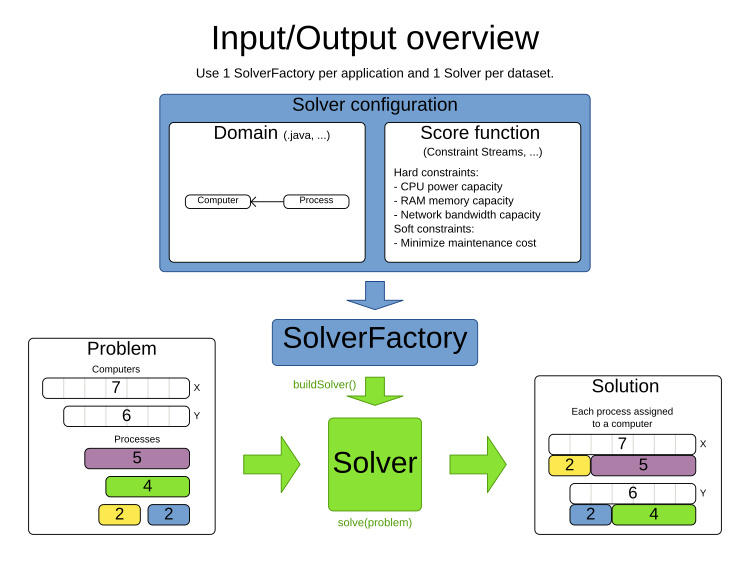
Using Timefold Solver: Overview
Timefold Solver can be used in two modes. Both build on the same modeling and constraint concepts, but differ in how you deploy and interact with the solver.
1. Run as a Service (recommended)
Deploy Timefold Solver as a standalone optimization service. This mode handles the REST API, solver lifecycle, and more.
Submit a planning problem via REST and receive optimized results asynchronously.
Configuration is done via application.properties.
This is the recommended approach for most teams: it lets you focus on modeling the problem and writing constraints rather than on plumbing. This is the approach we use ourselves at Timefold for models on our platform.
2. Use as a Library (advanced)
Embed Timefold Solver directly in your application for full control over the solving lifecycle. Use this approach when you need deep integration with existing infrastructure or have a use case or architecture where the recommended approach above doesn’t apply to you.
3. Common foundation
Regardless of mode, the following steps and concepts apply:
-
Model your planning problem as a class annotated with
@PlanningSolution, for exampleTimetable. -
Define constraints using a
ConstraintProviderthat expresses hard and soft rules. -
Submit your problem — via REST API (service) or
Solver.solve()/SolverManager(library). -
Receive the best solution found within the configured time limit.